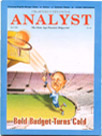
Cover
Story
Bold Budget Turns Cold
Yashwant
Sinha presented the Union Budget 2001-02 at a crucial time
when the global economy is passing through a downturn and
the Indian economy is also experiencing a slowdown. Expectations
regarding the budget were, thus, feeble. Under such odds,
surprising everyone, the finance minister presented a budget
that again restarted the engines of economic reforms, which
had come to a standstill. The budget has conceived powerful
ways to bridge the increasing fiscal imbalance, increase capital
inflows, remove infrastructure bottlenecks and reinforce investors’
confidence. All bold initiatives in the right direction. Both
corporates and investors have been given a fresh lease of
life. However, the exposures of Tehelka.com regarding the
defence scam, on the political side, and the payments crisis
followed by allegations of insider trading in the capital
markets have made all the bold initiatives appear very cold.
Swift and decisive action to redeem public confidence is the
need of the hour.
© IUP. All Rights Reserved.
Spotlight
Aagricultural
reforms: Need
of the hour -- N
Janardhan Rao
Why
the economic reform process did not touch the agriculture
sector? Surely, it is not the industrial sector alone that
deserves the benefits of reform. If the economy has to grow
fast, then the agricultural sector should play a crucial role
along with industry and services.
© IUP. All Rights Reserved.
Case
Study
Compaq
Digital Equipment Merger: Synergy
in sight? -- D
G Prasuna
Compaq
had always dreamt of being one of the top three computer makers
in the world. But its dream remained far removed from reality.
Its acquisition of Digital was a shot in the arm, which gave
it the necessary momentum and push to join the elite group
of one-stop suppliers previously limited to IBM and Hewlett
Packard. But the goal is as elusive as ever.
© IUP. All Rights Reserved.
Financial
Markets
Stock Market
Crash : Have
we reached the nadir yet? -- D
Satish
With
the stock markets around the world crashing and reaching new
lows doubts are being raised as to whether these markets have
reached the bottom or is there anything else to come.
© IUP. All Rights Reserved.
Credit
Derivatives
It
was the new international rules of the Basle Accord, 1988
that brought credit derivatives into existence. The Basle
norms required banks to set aside some part of their capital
against their loans. Banks seeking to reduce their exposure
and related risk-based capital requirements to corporate credits
have found credit derivatives to be more efficient than traditional
securitizations. A credit derivative is a financial instrument
used to mitigate or to assume specific forms of credit risk
by hedgers and speculators. They are particularly useful for
institutions with widespread credit exposures. It has the
potential to herald a new form of international banking in
which banks resemble portfolios of globally diversified credit
risk more than purely domestic lenders. Today credit derivatives
represent one of the fastest growing businesses in banking.
(See box ‘The wonderful idea of pedaling risk’ for
a detailed account of credit derivatives market).
© IUP. All Rights Reserved.
Debt Funds
: Bastions
of safety -- Aparna
Mehta
As
the equity markets continue to be riddled with risks, the
latest rage in the mutual funds market is debt. With a shift
in the perception of the investors, the debt fund market seems
to be all set for a turnaround.
© IUP. All Rights Reserved.
Business
Environment
Dirty
politics play spoilsport -- D
G Prasuna
There
has been a lot of pep talk with little actually being done
on the crucial issue of PSU reforms more specifically _ the
disinvestment. However, the process is no smooth ride when
it comes to implementation. The latest controversy, about
Balco, would prove to be a litmus test for government to show
its willingness and guts to push through further disinvestment
and PSU reforms.
© IUP. All Rights Reserved.
Industry
Global Steel
Industry : Consolidating
out of concerns -- Y.
Chandrasekhar
Many
global steel companies are under stress with the present price
crisis. To bail themselves out from the impending crisis,
steel producers around the world are moving towards consolidation.
Can this save the industry or is there any other viable alternative?
© IUP. All Rights Reserved.
Global
Steel Industry -Brighter prospects
The
global steel market continues to be in a state of flux. The
recent euphoria over the price recovery proved unjustified
as the real increase was only marginal. Finances for the steel
companies all over the world had become scarce and global
competition fierce. The survival strategies of the companies
have fewer leverages in terms of expansion of market presence
in their home markets.
© IUP. All Rights Reserved.
Financial
Services
VRS in
Banks -- D
Satish
The
public sector banks are going in for VRS to shed the flab.
This move should not be taken as a one off exercise. Rather
it should be the first step in the process of attaining the
long-term objective of strengthening the banking system.
© IUP. All Rights Reserved.
Perspective
UTIB-GTB
Merger : Whither
due diligence? -- Ch
Rajeshwer
Even
before champagne splashed around, the merger party ended abruptly.
Regulators should tighten the framework to avoid recurrence
of such events.
© IUP. All Rights Reserved.
Debate
Impact
of lower interest rates on economy
Over
the last five years a regime of low interest rates has set
in for the Indian economy. Despite the implementation of reforms,
structural rigidities remained in interest rate structure
distorting the true market-determined rates. Rates have been
kept artificially high by offering high administered rates
on small savings and provident fund. The gap between the short-term
and long-term rates tended to remain high on account of this.
The interest rates have been and continue to be very high
relative to the rates prevailing in global markets.
© IUP. All Rights Reserved.
|