|
Polyααmino acids may form either an a-helix or β-parallel and antiparallel
pleated sheets. The polyααmino acids may also exist as random coils in solution or solid
state. Polyααmino acids have been used for understanding the mechanism of
protein denaturation. They have also played an important role in the uncoding of the
genetic code. The antigenicity of protein and peptides depends on the composition of amino acids. Interest in the biological and physicochemical characteristics of
polyααmino acids was recently renewed because of the reported novel finding that some copolymers
of amino acids are effective drugs in multiple sclerosis and that glutamine repeats
and reiteration of amino acids occur in inherited neurodegenerative diseases.
Polyααmino acids and, in particular, poly-L-lysine have been used as excellent models for
investigating the mechanism of enzymatic protein hydrolysis and transpeptidation (Katchalski,
1997). Circular Dichroism (CD) has been used
for studying the conformation of
oligo-L-lysine (Lys, n = 9, 12 and 15) in the reversed micelles of bis(2-ethylhexyl)
sodium-sulfosuccinate (AOT) in octane by measurements. The oligomers seem to exist in b-sheet (Seno et al., 1985). Poly-L-lysine (PLL), the well-known non-viral condensing agent of DNA,
has recently been used for peptide-guided gene delivery (Martin and Rice, 2007).
PLLs ranging from a degree of polymerization (dp) of 90-450 (Wadhwa et al., 1997) are widely used. The PLL is suitable for in
vivo use because it is readily biodegradable.
However, with the increase in length, increase in cytotoxicity of PLL has been observed.
The transfection of PLL, when used alone, is modest, but the addition of either
an endosomolytic agent, such as chloroquine or a fusogenic peptide, allows the release
of PLL into the cytoplasm. The attachment of Poly (Ethylene) Glycol (PEG) to the
polymer prevents plasma protein binding and increases the circulation half-life of the
complex (Tang and Szoka, 1997; Elαneed, 2004; and Tiera et al., 2006).
The hexamethylene-linked oligo-L-lysine may be of considerable use in
peptide-guided gene delivery as it contains positively charged side chain amino groups
and lipophilic hexamethylene moiety, which can help the oligo-L-lysine-DNA condensate
to enter into the cells. Also these systems can be considered models for broken helices
which are formed in the intermediate state of the helix-coil
transition and also during the folding of helices in protein molecules. Conformational studies on hexamethylene
amine-linked g-benzyl-L-glutamate oligomers and also hexamethyleneamine-linked L-glutamic
acid oligomers have been described earlier (Kumar, 1987 and 1988). Here, we describe
the conformational studies of hexamethylenediamine (HMDA)-linked oligo-L-lysine
and hexamethylene-linked e'-benzyloxycarbonyl-L-lysine oligomers
(n = 8, 15, 19). |


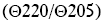 increases from 0.57 to 0.76. The HMDA
L-lysine oligomers at pH 6.6 and 12.6 have random coil structure and some degree of
ordered structure respectively. In sodium perchlorate, these systems show random coil
with some degree of ordered α-sheet structure. But ellipticities of the bands are low.
increases from 0.57 to 0.76. The HMDA
L-lysine oligomers at pH 6.6 and 12.6 have random coil structure and some degree of
ordered structure respectively. In sodium perchlorate, these systems show random coil
with some degree of ordered α-sheet structure. But ellipticities of the bands are low. 
