|
COVER
STORY
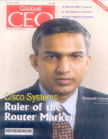
Cisco
Systems - Ruler of the router market
-- Ravi S Madapati
Cisco
was founded in 1984 by a small group of computer scientists
from Stanford University. Since the company's inception, Cisco
engineers have been prominent in the development of Internet
Protocol (IP)-based networking technologies. By the 2000s,
Cisco Systems became the worldwide leader in networking for
the Internet. Cisco has used acquisitionsmore than 80 since
1993to broaden its product lines and secure engineering talent
in the highly competitive networking sector. After the massive
technological spending of the Internet days, Cisco saw decline
in demand for its routers. But by 2004, Cisco is recovering
from the Internet downturn better than many other companies
in the Silicon Valley.
© 2004 IUP. All Rights Reserved.
STRATEGY
Beyond
SWOT analysis
-- Dilip Dasgupta
SWOT
analysis is an important tool that both students and managers
use to understand capabilities. Its applicability is wide.
This article, in the form of a real-world classroom discussion,
describes the various facets of management techniques such
as SWOT analysis, the BCG Matrix, and the GE/McKinsey Matrix,
among others. The protagonist of the article, Raman, observes
how a class of management students develop their analytical
skills based on these techniques. He notices that a number
of subjective factors appear to influence the group, coloring
their perspective and clouding their judgment. As a result,
even though the group did a greater degree of systematic work
with a SWOT framework of presentation, the diagnostic analysis
was not accurate and the solutions suggested did not appear
to be scientific enough. The article suggests alternative
frameworks.
© 2004 IUP. All Rights Reserved.
INNOVATION
The
seeds of innovation
-- Elaine Dundon
The
challenge for most organizations is to balance the pursuit
of innovation. If the organization excessively pursues efficiency
innovation, being too focused on improving the productivity
of what already exists, then it runs the risk of missing opportunities
in the marketplace. With a highly revolutionary innovation,
the organization runs the risk of creating a state of chaos
and also disenfranchising those employees who do not have
the mindset or the skill base to identify and pursue radically
new changes in direction. The article gives insights into
various types of innovation.
© 2004 IUP. All Rights Reserved.
MANAGEMENT
What
makes a good decision?
-- AV Vedpuriswar
Decisions
are typically classified in management literature as strategic,
tactical and operational, depending on the type of impact
they make. Strategic decisions are considered irreversible
and have long-term implications. To encourage better decision-making,
the top management must lead by personal example. They must
encourage people to take decisions without unduly worrying
about failure. Important decisions should consume more time,
and involve the top management, rather than less important
ones. Unfortunately, in most Indian organizations, decision-making
has little to do with their importance.
© 2004 IUP. All Rights Reserved.
FINANCE
Stock
options: To expense or not?
-- Ravi S Madapati
The
plethora of accounting scandals that broke out after the Enron
debacle has drawn attention to expensing stock options. Experts
believe the widespread overstatement of earnings due to the
non-recognition of option expense is misleading investors
about the true earnings capacity of their companies. The debate
on whether or not stock options must be expensed has divided
corporate America into two rival camps. There is also a debate
on when to expense the stock optionsat the time of issue or
at the time of exercise by the employee. As 2004 progresses,
the debate on expensing stock options has become more intense.
© 2004 IUP. All Rights Reserved.
CORPORATE
SOCIAL RESPONSIBILITY
Corporate
social responsibility at Cisco Systems
-- Arun Khan
Cisco
Systems continues to dominate the market for equipment used
to link networks and power the Internet. The company's bread
and butter products are routers and switches. Cisco pursues
a strong "triple bottom line," which it describes as profits,
people and presence. Profits are one traditional and valuable
metric, which helps measure the financial performance. People
are equally important. Strong, mutually beneficial relationships
with partners, customers, shareholders and the people who
work for, with and near it are crucial for Cisco's business.
The third bottom linepresence, measures its standing in respect
for and contribution to global and local communities.
© 2004 IUP. All Rights Reserved.
BUSINESS
ETHICS
Mafia
managers
-- Vinay Dutta
Super
ordinate goals, intense competition, flat structures, technological
advancements, emerging skill-sets, proactive management styles
all sound exciting and challenging. But are these the raison
d'être forcing the so-called present day professionally qualified
business managers to indulge in dicey activities and unethical
business practices?
© IUP. All Rights Reserved
|