|
INTERVIEW
PM Speak
-- Patrick Gray
Project managers must be leaders to a great extent, and must also be excellent communicators, who can rally assistance when a project begins to struggle.
© 2008 IUP . All Rights Reserved
COVER STORY
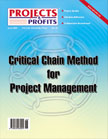
Underpinnings of Critical Chain Method for Project Management in Statistics and Behavioral Psychology Theories
-- Gautam V Desai
Critical Chain Management, one of the newer techniques for managing project risks related to the project schedule, was developed by Eliyahu M Goldratt. The technique lays emphasis not just on the network analysis as such, but on the entire project management paradigm. Hence, for reaping the full benefits from the technique, a major shift in the organization's project management policies and procedures is necessary. The technique has a potential to offer an order of magnitude improvement in shortening the project schedule for a reasonably sized complex project. This article is meant to be an introduction to the technique, its basic features, important steps in its application and, most importantly, the theoretical underpinnings of the technique in the statistics and behavioral psychology theories.
© 2008 Gautam V Desai. All Rights Reserved.
ORGANIZATION E-READINESS
Success of Collaborative Environments in Project Management :Organization E-Readiness
-- Mustafa Alshawi and Eric Choen Weng LOU
Collaborative environment for construction project management is widely accepted as an essential element to address construction business improvement. However, there are still many problems in adopting it. Various case studies have shown people and processes in organizations as critical success factors; but not the technology. Organizations can address this issue further through the ability to measure electronic readiness (e-readiness) of their organization, enabling them to adopt and use the available Information and Communication Technologies (ICT) to improve their business strategies and performance and service to customers. E-readiness reflects organizational soft issues such as business processes, management structure, change management, people and culture.
© 2008 IUP . All Rights Reserved
POWER PROJECTS
Ultra Mega Power Projects : Issues and Challenges
-- GD Rathod
With ever-increasing demand for electricity, the Government of India (GoI) has started the development of Ultra Mega Power Projects (UMPPs) on Build, Own and Operate (BOO) basis. This article analyzes the status and various emerging issues related to development of UMPPs.
© 2008 IUP . All Rights Reserved
PROJECT ENVIRONMENT
Schedule Adherence :A Useful Measure for Project Management
-- Walt Lipke
Earned Value Management (EVM) is a very good method of project management. However, EVM by itself cannot provide information as to how the schedule is being accomplished. Project accomplishment not in accordance with the planned schedule has adverse repercussions; cost increases and duration is elongated. Thus, managers have to understand the project performance. This article utilizes the new practice of Earned Schedule (ES) to discuss a proposed measure for further enhancing the practice of EVM. The measure, Schedule Adherence, provides additional early warning information to project managers, thereby enabling improved decision-making and enhancing the probability of project success.
© 2008 Walt Lipke. This article was first published in April 2008 issue of Crosstalk magazine. Reprinted with permission.
PROJECT ENVIRONMENT
IT Projects : Stress Management
-- N Vijaya Lakshmi
Stress is the most dreaded word in project environment, especially in IT projects, as the increasing globalization and technological advancements are leading to levels of stress never before experienced.
© 2008 IUP . All Rights Reserved
PROJECT QUALITY
Measuring and Managing Project Quality :If You Can't Measure It, You Can't Manage It
-- Stacy A Goff
Quality of a project's results is a better indicator whether the business needs are met than any other factor. Yet, in so many projects, quality is either a secondary consideration, or the first "area of flexibility" to reduce, when other factors such as time or cost are under pressure. Why is this too often the case? In part, because quality is difficult to measure until it is too late to do so. This article explores the challenges of measuring and managing project quality, with suggested quality indicators for situations where outright measures are not available.
© 2008 Stacy A Goff (www.projectexperts.com). Reprinted with permission.
PROJECT STRATEGY
Change Management
-- Manoj Deshmukh
Change management-dealing with changes-is a key project management function for any industry. There may be enormous variance in efforts, cost, schedule, quality of deliverables if changes are not handled effectively. Many projects are delayed and many others are closed (terminated) because project managers are not able to manage changes.
© 2008 Manoj Deshmukh. This article was first published in April 2008 in the Project Perfect website (www.projectperfect.com.au). Reprinted with permission.
PROJECT TOOLS
WebTop Suite : A Tool for Project Collaboration
-- V Venkateswara Rao
With the new desktop application suite, organizations can deliver personalized information, provide real-time business information and enable real-time ad hoc collaboration among the stakeholders. Most importantly, the new application enables organizations to develop a new channel to improve end-user retention.
© 2008 IUP . All Rights Reserved
|