Welcome to Guest !
 
       IUP Publications
              (Since 1994)
Home About IUP Journals Books Archives Publication Ethics
     
  Subscriber Services   |   Feedback   |   Subscription Form
 
 
Login:
- - - - - - - - - - - - - - - - - -- - - - - - - - - - - -
-
   
- - - - - - - - - - - - - - - - - - - - - - - - - - - - - - -
 
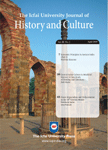
The IUP Journal of History and Culture

April '09
Focus

Economic growth results when the output of an economy grows because more land, labor, capital, and entrepreneurial talent are devoted to the production process and/ or because the `productivity' of these factors of production rises.

Articles
   
Price(INR)
Buy
Economic Principles in Ancient India(Part I)
Central Asian Culture in Medieval Deccan: A Case Study of Painting and Literature
Green Imperialism and Deforestation in the 19th Century British Northern India
Select/Remove All    

Economic Principles in Ancient India(Part I)

-- Nicholas Kazanas

The paper deals with economic principles as found in the more ancient sources of the Vedic period in so far as this is possible. This should be grasped very thoroughly. Unlike a particular practice or application of a law which may well be affected by circumstances and thus appear to be different from place to place and time to time, a principle has an unchanging and eternal quality. Despite few economic terms used throughout the text like Land Value Taxation (which means simply taxing the value of land alone) there is nothing complex or complicated in this study and reading it does not require any training in Economics. By showing the relation of the Indic principles to certain modern concepts and particularly to Land Value Taxation the paper goes a long way in bringing into light many valuable economic concepts and practices supported by an institutional framework. The revisiting of the ancient Indian economy becomes much imperative while studying the phenomenal changes taking place in modern times.

Article Price : Rs.50

Central Asian Culture in Medieval Deccan: A Case Study of Painting and Literature

-- Salil Kader

The Deccan region during the medieval period saw the development of a new, syncretic culture. This development was brought on by the arrival of Central Asians and Persians to the region around the 13th century AD. The blending of the indigenous culture with that of the Perso-Central Asian culture, gave rise to a distinctive Deccani culture. The fact that various ruling dynasties of the region like the Bahmanis, followed by the Adil Shahis, the Qutb Shahis, and the Nizam Shahis traced their roots to Persian or Central Asian sovereigns played a crucial role in facilitating the growth of this syncretic culture. The impact of the Perso-Central Asian culture was seen on areas such as architecture, language and literature, art, polity and religion. This paper aims at briefly studying the body of paintings and literature produced in the Deccan between the 14th and 17th centuries, and the various foreign influences that shaped them.

Article Price : Rs.50

Green Imperialism and Deforestation in the 19th Century British Northern India

-- Om Prakash

The British colonial empire throughout the world had varying forms of administrative and exploitative tools based upon the prevailing local conditions. Among the various forms and methods of colonization, one of the forms was to put the biodiversity and green resources for their commercial and greedy ends. Thus the phenomenon of green imperialism by the British exploiters, having a universal character, witnessed the similar course and impact in the case of the Indian situation. The various justifications given by the British for exploitation of such resources have found a significant presentation in this paper. However, the exploitation of flora and manipulation of certain plant species disturbed the biodiversity of the forest and it brought tremendous climatic change due to deforestation, extinction of variety of flora and fauna, etc.

Article Price : Rs.50

Partisans of Allah: Jihad in South Asia

-- Author: Ayesha Jalal, Reviewed by Laxman D Satya

Islam: Misgivings and History

-- Author: Asghar Ali Engineer, Reviewed by Akhtarul Wasey

Search
 

  www
  IUP

Search
- - - - - - - - - - - - - - - - - - - - - - - - - - - - - - -
 
- - - - - - - - - - - - - - - - - - - - - - - - - - - - - - -
 
- - - - - - - - - - - - - - - - - - - - - - - - - - - - - - -

Click here to upload your Article

- - - - - - - - - - - - - - - - - - - - - - - - - - - - - - -
Automated Teller Machines (ATMs): The Changing Face of Banking in India

Bank Management
Information and communication technology has changed the way in which banks provide services to its customers. These days the customers are able to perform their routine banking transactions without even entering the bank premises. ATM is one such development in recent years, which provides remote banking services all over the world, including India. This paper analyzes the development of this self-service banking in India based on the secondary data.

The Information and Communication Technology (ICT) is playing a very important role in the progress and advancement in almost all walks of life. The deregulated environment has provided an opportunity to restructure the means and methods of delivery of services in many areas, including the banking sector. The ICT has been a focused issue in the past two decades in Indian banking. In fact, ICTs are enabling the banks to change the way in which they are functioning. Improved customer service has become very important for the very survival and growth of banking sector in the reforms era. The technological advancements, deregulations, and intense competition due to the entry of private sector and foreign banks have altered the face of banking from one of mere intermediation to one of provider of quick, efficient and customer-friendly services. With the introduction and adoption of ICT in the banking sector, the customers are fast moving away from the traditional branch banking system to the convenient and comfort of virtual banking. The most important virtual banking services are phone banking, mobile banking, Internet banking and ATM banking. These electronic channels have enhanced the delivery of banking services accurately and efficiently to the customers. The ATMs are an important part of a bank’s alternative channel to reach the customers, to showcase products and services and to create brand awareness. This is reflected in the increase in the number of ATMs all over the world. ATM is one of the most widely used remote banking services all over the world, including India. This paper analyzes the growth of ATMs of different bank groups in India.
International Scenario

If ATMs are largely available over geographically dispersed areas, the benefit from using an ATM will increase as customers will be able to access their bank accounts from any geographic location. This would imply that the value of an ATM network increases with the number of available ATM locations, and the value of a bank network to a customer will be determined in part by the final network size of the banking system. The statistical information on the growth of branches and ATM network in select countries.

Indian Scenario

The financial services industry in India has witnessed a phenomenal growth, diversification and specialization since the initiation of financial sector reforms in 1991. Greater customer orientation is the only way to retain customer loyalty and withstand competition in the liberalized world. In a market-driven strategy of development, customer preference is of paramount importance in any economy. Gone are the days when customers used to come to the doorsteps of banks. Now the banks are required to chase the customers; only those banks which are customercentric and extremely focused on the needs of their clients can succeed in their business today.

more...

 
View Previous Issues
History and Culture